Haij

Open source · AGPL-3.0 · Hosted in the EU or on your own servers

Tools for work.
Come on in.

Haij is a small collection of open source tools for work: customers and hours, projects and teams, and AI that stays in the EU or on your own machine. We build them because we need them ourselves, and we use them every day. You can try them, read the code and run them yourself.

We write down what is in production, what is new, and what is still only a good idea.

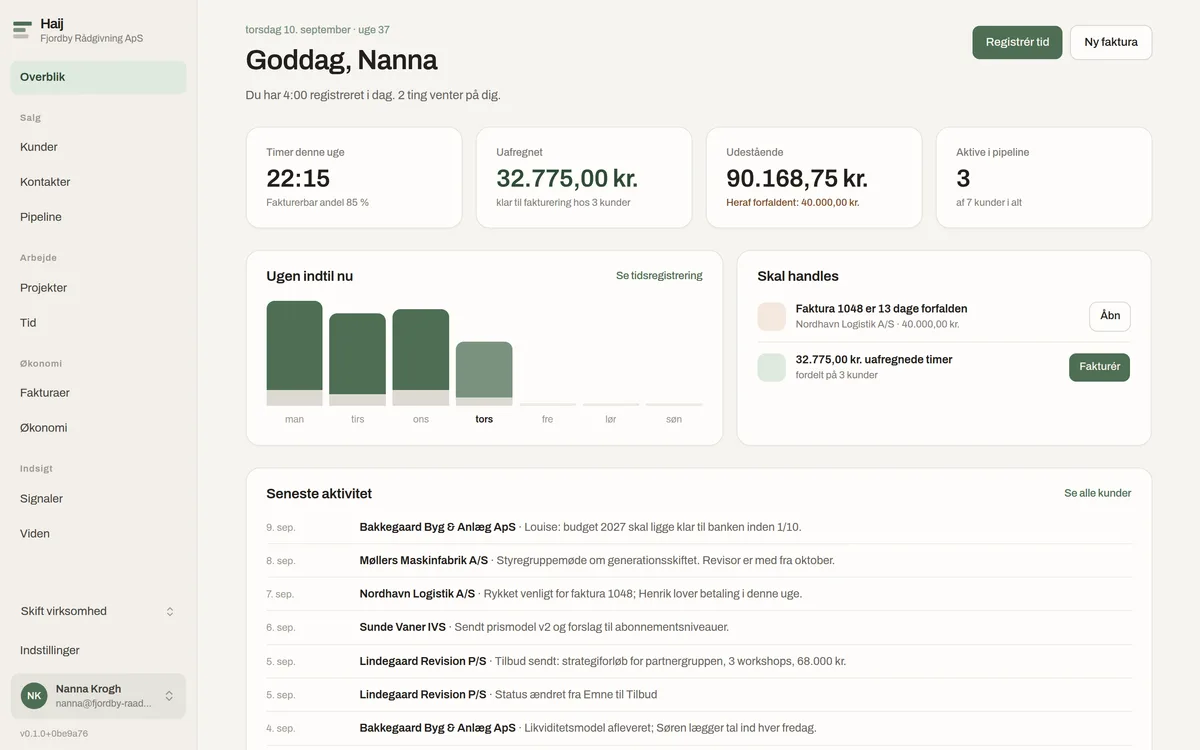
The overview in Forretning: hours this week, unbilled, outstanding, the week so far and what needs action

The window

The tools

Five you can try today, one is on its way. They are built for real work, and they all stand on the same foundation: workspaces separated in the database, an audit log, passkeys and export of everything. That is why they can start as a playground for one team and hold up when a whole organization moves in.

The overview in Forretning: hours this week, unbilled, outstanding, the week so far and what needs action

Forretning

In production

app.haij.dk

Customers, hours and invoices in one place.

For solo consultants and small companies that want to keep track of customers, hours and invoices without buying a big system. Customers are looked up in the Danish company register, invoices meet the Danish requirements, and finances and small projects sit alongside. There is also a knowledge center and an MCP server, so your AI assistant can read your numbers and write drafts. It is not allowed to send anything.

We use it ourselves every day and have since September 2026. Access on application.
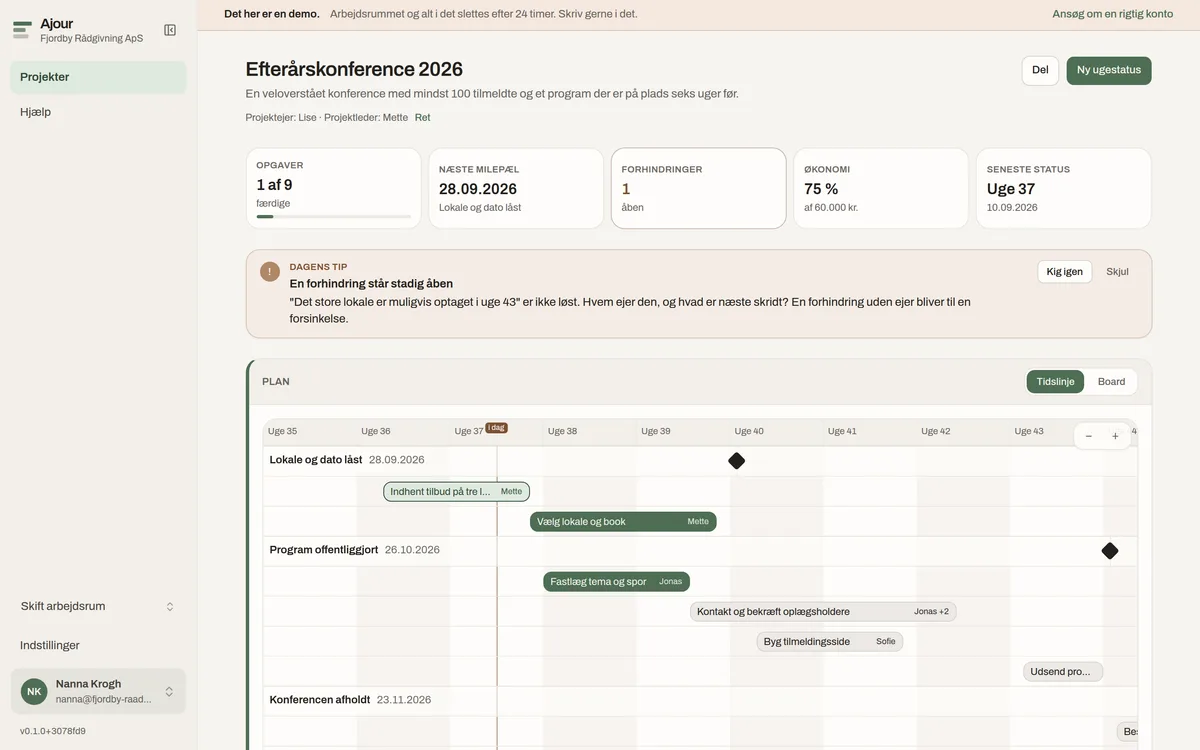
A project in Ajour: tasks, next milestone, obstacles, budget and a week-by-week timeline

Ajour

New

ajour.haij.dk

A plan that keeps up with reality.

For small projects with 2 to 10 people. Describe the project in your own words and get goals, milestones and tasks to start from. Every week the AI drafts the status and suggests changes when reality has moved. You say yes or no, and everything can be undone.

Live since September 2026. Still young, so tell us if something gets in your way.

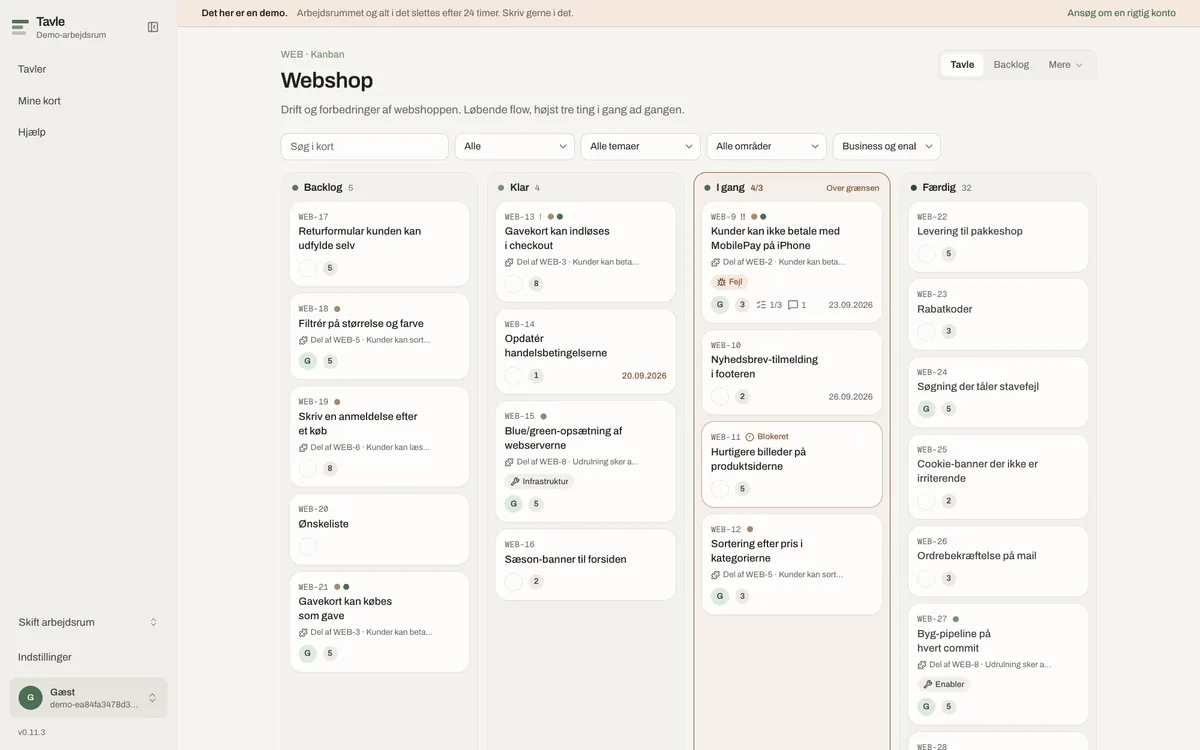
A Kanban board in Tavle: the columns Backlog, Ready, In progress and Done, and a WIP limit exceeded in In progress

Tavle

New

tavle.haij.dk

Kanban and Scrum, without it becoming a system.

A board for teams of two to fifteen: the product team, the ops team, the association's app project. Run Kanban with WIP limits that warn but never forbid, or Scrum with a backlog and one sprint at a time. Burndown, velocity, throughput and cycle time are computed from what actually happened to the cards, not from an estimate. The AI can finish writing a card, suggest a split, tell the sprint's story and make a first draft of backlog and roadmap from your own text. You edit and say yes.

New, September 2026. Version 0.11 is complete as a product, and now it needs a real team on a real board. Try the demo without an account, or apply for access.

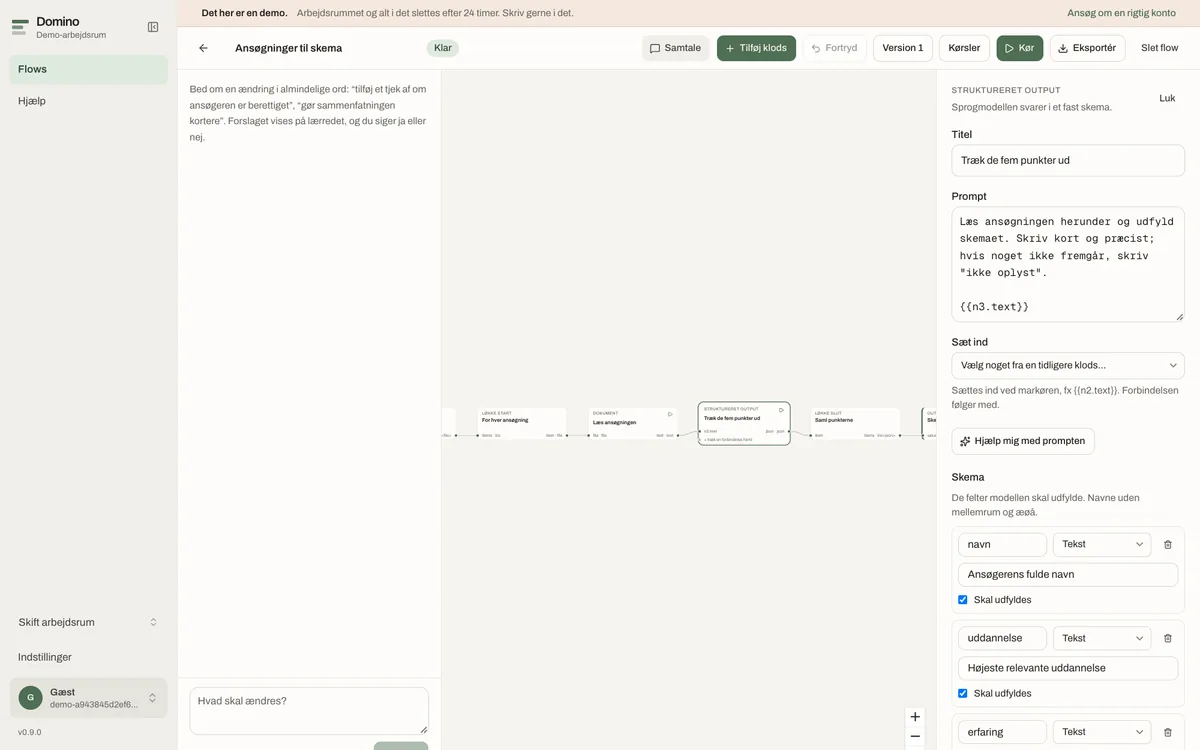
A flow in Domino: bricks for loop, document, structured output and schema, with one brick's panel open showing its prompt and fields

Domino

New

domino.haij.dk

Line the bricks up. Push the first one.

A visual flow builder for AI workflows, for people who do not program. You say what you want, such as "read the two hundred applications, pull five points out of each and put them in a table", and the model lines up the bricks. You adjust it on the canvas or in the conversation, test on one example, then run the whole pile and watch it happen brick by brick. A flow is one file you can export, import and keep under version control. Runs at Mistral in the EU or on your own machine with Ollama.

New, September 2026. Version 0.9 is built, and now it needs the first real pile. Try the demo without an account, or apply for access.

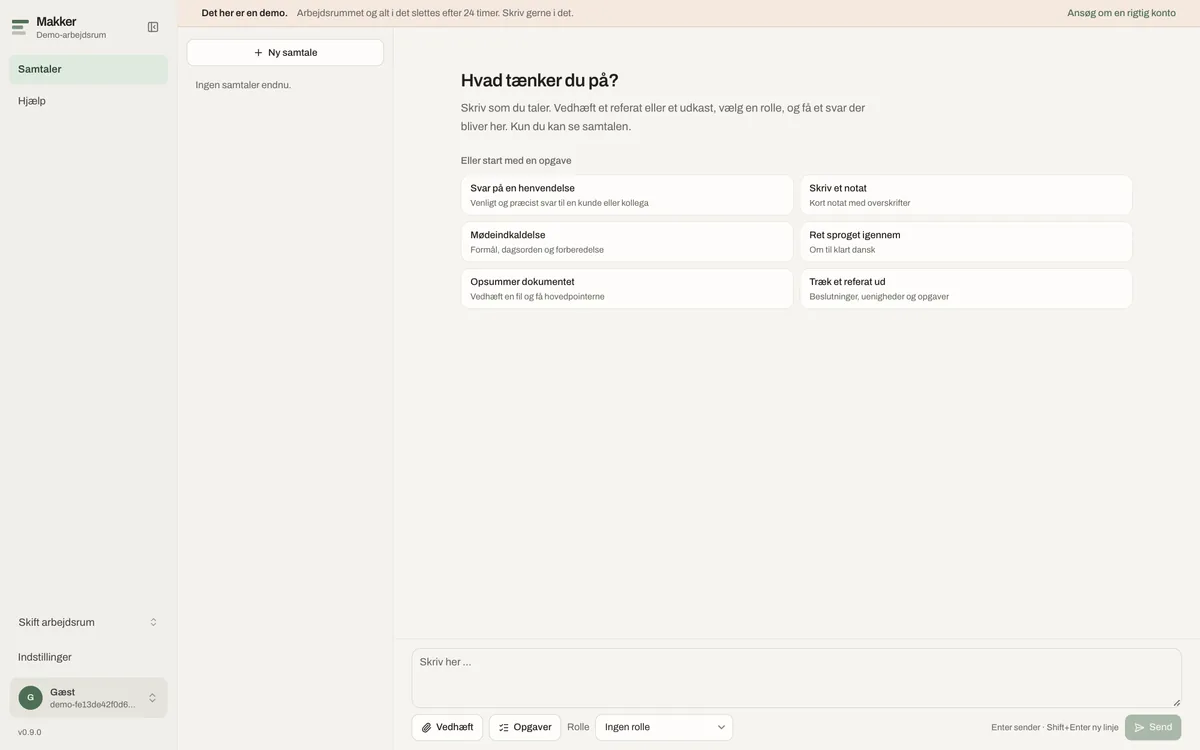
The start screen in Makker: a writing field, a role picker and a library of tasks such as answering an enquiry, a memo and a meeting invitation

Makker

New

makker.haij.dk

Someone to think out loud with.

A chat on top of language models that stay in the EU or on your own server. Write the way you talk, attach minutes or a draft, pick a role such as sparring partner, devil's advocate or plain-language editor, and read the answer as it is written. Ask for a memo or a deck and download it as Word or PowerPoint. A filter in the browser stops personal data before it leaves the machine, and every conversation is your own: nobody else in the workspace can see it, not the boss either. Runs at Mistral in the EU or on your own machine with Ollama.

New, September 2026. Version 0.9 is built, and now it needs the first real week of thinking out loud. Try the demo without an account, or apply for access.

On its way into the window

The code exists, and it has done real work at a customer. It is missing the last bit before we show it: a clean-up, a demo and a README you can follow. We write here when it moves.

Portefølje

Coming

portefolje.haij.dk

The quarterly rhythm of a portfolio.

Ideas, initiative cards, capacity, the prioritization meeting, status reports and a decision log, and a project room with phases, decision points, risks and benefits. It was built for and is used at a customer, and goes in the window once we have made it generic.

Seven dogmas

What we sign up to.

The rules every tool in the window follows, no matter who built it. They are written so you can check them, not so they sound good. The Danish wording is the original.

Seven is a lot. We tried merging some, but every time we lost something that can be checked.

See the checklist before the window

  1. Real open source.

    All code is public under AGPL-3.0. Everything we run can be downloaded 1:1 and run somewhere else or locally, and there are no features that can only be had on haij.dk. A paid edition is fine, but it is built on the same code. Clone the repository and you get exactly what runs on haij.dk.

  2. Run it yourself.

    Every tool can run in your own environment on a single server with Docker Compose, a Postgres and a local language model through Ollama, without a single key to any cloud. Features that depend on an external service, such as company register lookups or e-invoicing, say so plainly and let the rest work instead of breaking. The test is simple: cut the internet connection, and everything essential must still work.

  3. Your data, always.

    Everything an organization owns can be taken out with one click in open formats (spreadsheet, JSON, PDF) without asking anyone, and deleted completely again. Leaving Haij must take a few clicks and no unnecessary friction, and we would rather help with the move than make it hard.

  4. EU, or your own servers.

    When we host, everything sits with EU-owned providers on EU soil, language models included, and every tool has a public list of who can see what. No American cloud in operations. The code lives on GitHub, which is code hosting and not customer data; a mirror at a European forge comes the day it makes sense.

  5. AI assists, people decide.

    AI may suggest, draft and adjust plans, but never send anything out of the house, delete anything or commit anyone without a person saying yes. Everything AI does can be undone. Content fetched from outside is treated as data, never as instructions.

  6. Security from day one.

    Organizations' data is separated in the database, not only in the code, and there must be a test that proves it. Every change is recorded in a log that cannot be edited. Passkeys and two-step login are there from the start, there is a public way to report security holes, and there are never secrets in the code.

  7. Used for real.

    Nothing we have built ourselves goes in the window before it has done real work, for us or for a customer we sit close to. Tools from others must have a real place of use we can point to. We do not keep tools around that have not created real value in practice.

How

Three ways in.

The code is the whole code, and it is free. What you can pay us for is operations, maintenance, support and advice. Not features held back.

02

Run it yourself

Clone the repository, run docker compose up, and point it at your own Ollama. One server, one Postgres, no keys to any cloud. That is enough to try it on a Friday afternoon, and it is the same setup that runs in a real production environment.

03

Let us run it for you

If you want a tool hosted for your organization, we make an agreement on operations, backup, uptime and support at a price that covers the work. If you would rather run it in your own data center or with your own provider, we help you get started. It is the same code wherever it runs.

About

About Haij

Haij is run by Vinther Consulting and was started by Martin Nymann Vinther. Martin has worked on large organizations' transformations for two decades, and the tools here grew out of that work: things we were missing, and would rather build properly than buy half-finished.

There are no investors and no growth plan. Haij is as much a workshop as a product: a place where we try things out, in the open, but with the same demands on security and data that a large organization would make. That is why there are dogmas and a checklist, and not just a roadmap.

The code is public, and you are welcome to use it, read it, report what you find and send changes. If you want a tool hosted, or you have one of your own that lives up to the dogmas, write to us.